






Blog
Offshore Company Benefits: What You Gain and What You Must Do
Incorporating offshore provides strategic advantages, from tax efficiency to asset protection. However, modern compliance rules require proper planning and execution. see more...
Toll-Free Numbers from these locations. Click to Call for Free
 Austria
 Czech Republic
 Estonia
 Ireland
 Latvia
 Malta
Malta
 Poland
 Romania
 Slovakia
Austria VASP
Slovakia
Austria VASP
 Bulgaria VASP
 Cyprus VASP
Czech Republic VASP
Estonia VASP
Cyprus VASP
Czech Republic VASP
Estonia VASP
 France DASP
 Finland VASP
 Lithuania VASP
 Luxembourg VASP
Malta VASP
Poland VASP
Luxembourg VASP
Malta VASP
Poland VASP
 Portugal VASP
Slovakia VASP
Portugal VASP
Slovakia VASP
 Italy CASP
 Anjouan
 Anguilla
 Antigua & Barbuda
 Aruba
Aruba
 Bahamas
 Bahrain
 Barbados
 Belize
 British Virgin Islands
 Brunei
 Canada LP
 Cayman Islands
 Costa Rica
 Curacao
 Gibraltar
 Great Britain LLP
 Guernsey
Ireland LP
Guernsey
Ireland LP
 Isle of Man
 Jersey
 Labuan
 Marshall islands
 Mauritius
 Panama
 Saint Kitts & Nevis
 Saint Vincent and Grenadines
Scotland LP
Saint Vincent and Grenadines
Scotland LP
 Seychelles
 Vanuatu
Prediction-market monthly transaction volume grew from about USD 1.2 billion in early 2025 to over USD 20 billion in January 2026, suggesting that the category is moving beyond niche users into wider retail participation.
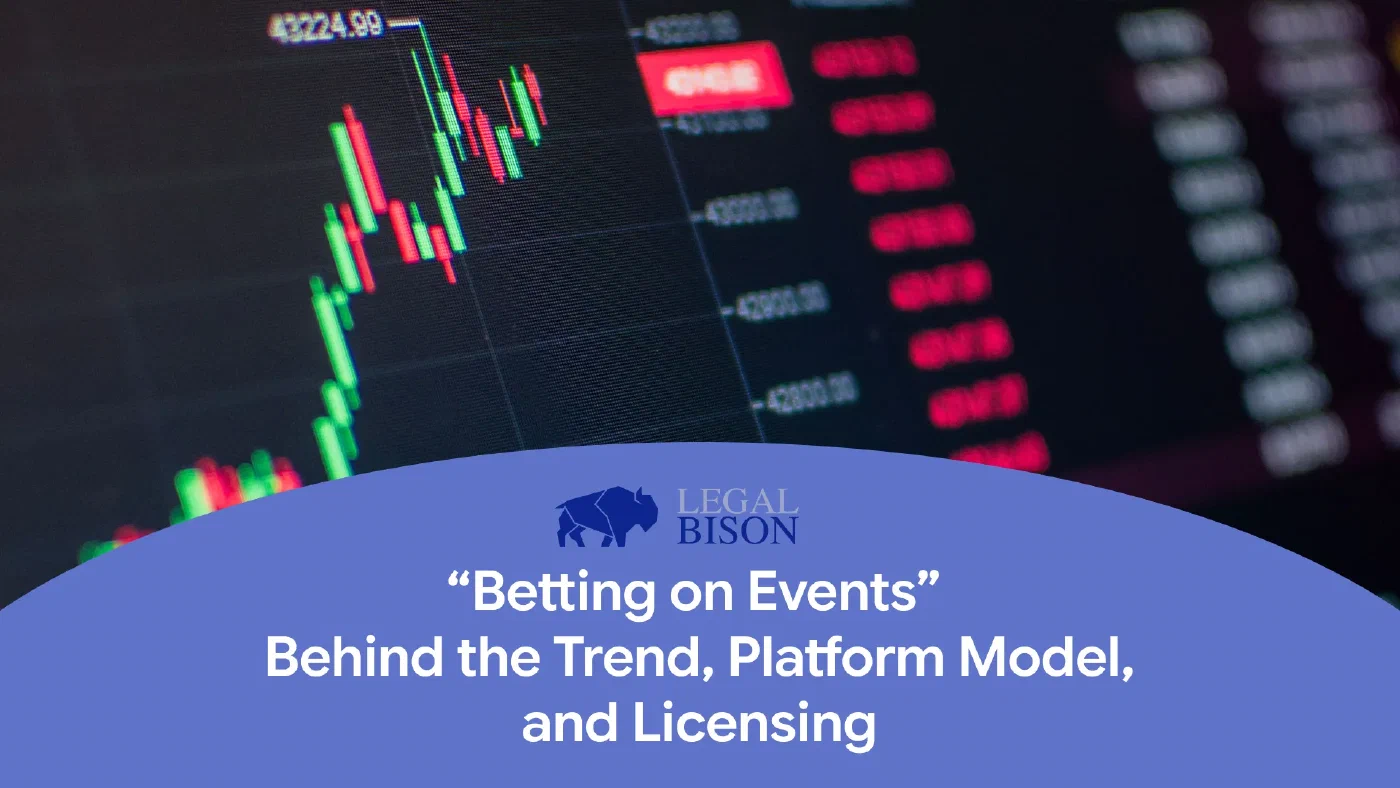
People are no longer just betting on sports, they’re betting on events; elections, weather, crypto prices, and even macro-economic shifts. But here’s the problem, sometimes founders don’t know what they’re actually building from a regulatory standpoint.
Event contracts are best understood not as hype, but as a market response to a deeper shift. People increasingly want to trade on real-world uncertainty the same way they trade stocks, options, crypto, or sports markets. The format is simple, yes/no outcomes around future events but the demand behind it is broader. Elections, interest rates, climate events, crypto volatility, sports, and pop culture are no longer just news topics, they are becoming tradable moments.
The format is simple, yes/no outcomes around future events but the demand behind it is broader.
TRM Labs reported that prediction-market monthly transaction volume grew from about USD 1.2 billion in early 2025 to over USD 20 billion in January 2026, suggesting that the category is moving beyond niche users into wider retail participation.
The lines between gambling, trading, and pure speculation haven’t just been blurred; they’ve been completely rewritten. Look at the massive waves being made right now:
The market is moving at a breakneck pace, and crypto, AI, and prediction mechanics are fusing into a financial-entertainment powerhouse. But as a founder, how do you step into this gold rush without getting shut down by regulators? Let’s break down the reality.
Also read: How Much Is the Gambling Industry Revenue Globally?
So, the compliance paradox here is: The exact same product can be treated as a revolutionary financial tool in one country, a regulated gambling game in another, and completely illegal in a third.
Many entrepreneurs dive headfirst into development thinking, “It’s just a prediction market, not a sportsbook!” Regulators do not care what marketing buzzwords you put on your landing page. They care about your product’s underlying architecture, how money flows, and where your users live.
The legal classification of your “betting on events” platform depends entirely on its structural mechanics and your geographic footprint.
Related: What Happened with the Recent Polymarket’s Influencer Campaign?
To understand the prediction market apps landscape clearly, it helps to look at how platforms actually operate rather than how they describe themselves. Take KalshiEX, a fully regulated Designated Contract Market. It operates under CFTC oversight with mandatory surveillance, reporting, and customer protection standards.
In 2026, the CFTC issued an enforcement advisory after fraud and misuse of non-public information surfaced on the platform. The message is clear: regulated prediction markets are treated as financial market infrastructure, not betting apps.
To figure out where your business stands, let’s skip the dry textbook definitions. Instead, find yourself in the scenarios below:
If you are building this: You have a platform where users place fixed-odds bets against the house or via a pool on predefined events (like traditional sports, esports, or casino-style outcomes).
The Reality: This is gambling, plain and simple. It requires a standard sports betting or iGaming license.
If you are building this: You are creating a peer-to-peer marketplace. Instead of betting against a bookmaker, users buy and sell shares in the outcome of future events (example, “Will the Fed cut rates in Q3?” or “Who will win the next major election?”). The prices fluctuate based on supply and demand.
The Reality: This sits in a complex regulatory grey zone, often crossing over into financial derivative territory depending on how contracts are structured.
If you are building this: Your users are speculating on price movements, macro metrics, or specific indices using rapid-fire binary options (“Yes/No” payouts if a price hits $X by 4:00 PM).
The Reality: This looks, smells, and operates like a financial instrument, moving you straight into the crosshairs of financial conduct authorities.
If you are building this: You are launching a social prediction platform where users wager Web3 tokens, earn virtual points, or participate in gamified leaderboards to predict pop-culture moments or crypto trends.
The Reality: Your regulatory risk depends heavily on whether those tokens have real-world monetary value or if the “points” can be cashed out.
Also read: What are the Differences Between Prediction Market vs. Sportsbook?
We speak with dozens of brilliant founders who think they are building a “community platform.” Regulators don’t look at communities, they look at cash flows.
| What Your Business Looks Like | What It Actually Is to Regulators | The Required Licensing/Structural Reality |
|---|---|---|
| Sports Betting / Esports Book | Pure Gambling | Traditional iGaming License (e.g., Curaçao, Malta, Anjouan, or state-by-state US licenses). |
| Prediction Market (Elections/Macro) | Peer-to-Peer Financial Exchange / Event Contracts | Highly scrutinized. In the US, it falls under the CFTC or SEC (unless using a play-money model like Meta’s early phases). Outside the US, it may require a financial market operator license. |
| Crypto/Token-Based Betting | Web3 Gambling + Token Speculation | Dual Requirement: A Virtual Asset Service Provider (VASP) registration/license plus an iGaming license to legally handle the wagering element. |
| Social & Gamified Prediction | Engagement Tool or Unregulated Speculation | Depends on the reward. If it uses pure play-money with zero cash-out value, it’s low risk. If points can be traded for crypto or cash, it defaults to gambling or financial rules. |
At LegalBison, we have seen incredibly innovative businesses fail, not because there wasn’t a market for their product, but because they structured their corporate setup incorrectly from day one.
When you build a platform that monetizes uncertainty, you generally face four licensing paths:
The Golden Rule: Licensing is not based on what you call your product, it’s based on how it operates.
Also read: What Is a Social Casino, and How Does This Business Make Money?
The regulatory map is shifting under our feet. Staying ahead of it is how you build a resilient, venture-backed enterprise.
Crypto has successfully removed geographic boundaries for users, but it has forced regulators to react. For example, popular platforms like Kalshi recently barred users from India following strict domestic government crackdowns on prediction venues.
Despite the regulatory heat, investors are pouring millions into event-betting, gamified trading, and decentralized prediction markets. Capital flows toward teams that have an aggressive growth strategy paired with a bulletproof legal structure.
The market demand for event betting is undeniable. A massive psychological shift has occurred: users no longer just want to consume news, they want to trade on their real-world knowledge, whether it’s a Supreme Court decision, an AI breakthrough, or even a memecoin launch trajectory.
Because this market is moving significantly faster than regulation, founders are looking at an unprecedented window of opportunity. However, capitalizing on this gold rush requires you to structure your business defensively from the absolute start.
Experienced operators know that they can’t just launch a platform and hope for the best; they must design corporate structures that banks, regulators, and payment providers can actually work with. Instead of risking the entire enterprise on a single company, seasoned founders deploy strategic, multi-entity setups. By isolating payment processing, ring-fencing core technology IP, and separating operational risk, you can safely navigate complex, multi-jurisdictional rules without exposing your main business to sudden regulatory shifts.
The market window for monetizing global uncertainty is wide open right now, but the margin for legal error is rapidly shrinking. Don’t wait until you receive a regulatory freeze or a cease-and-desist letter to figure out your licensing strategy.
If you’re ready to build a resilient, venture-backed platform that protects your equity and secures your banking and crypto rails, let’s map out a bulletproof corporate structure at LegalBison today.
What is it called when you bet on events?
If you bet against a house: event betting (gambling). If you trade contracts peer-to-peer: prediction market (financial instrument). The structure, not the name, determines the regulation.
Can you bet on current events?
Yes. Platforms like Polymarket and Kalshi do this at a massive scale. Whether you can legally offer it depends entirely on your jurisdiction and how your platform is structured.
What is the most widely bet-on event?
US presidential elections dominate prediction markets. Globally, the FIFA World Cup and Super Bowl lead traditional sports betting volumes.
Is prediction market gambling?
Not necessarily. A peer-to-peer exchange functions like a financial market. A player-versus-house setup functions like a sportsbook. The mechanics decide.
Do I need a gambling or financial license?
Depends on your model. Player-versus-house typically needs a gambling license. Peer-to-peer event contracts may need a financial license. Crypto adds a VASP layer (or the other way around). Many platforms require more than one.
Biggest risk of launching without a license?
Cease-and-desist orders, frozen assets, lost banking, and a dead fundraising trail. We’ve seen strong products collapse because licensing was treated as an afterthought.
Incorporating offshore provides strategic advantages, from tax efficiency to asset protection. However, modern compliance rules require proper planning and execution. see more...
This guide breaks down Anti-Money Laundering (AML) compliance for crypto, FinTech, and digital asset founders; covering core regulations, key global authorities, the five essential compliance pillars, and practical strategies to meet jurisdictional standards. see more...
Moving a real-world asset onto a blockchain requires a solid legal and regulatory foundation before any technical work begins. Legal classification, entity setup, regulatory filings, and compliance infrastructure must all be established before the first token is minted. see more...